Fighting Bob Cain
By: Aaron Heft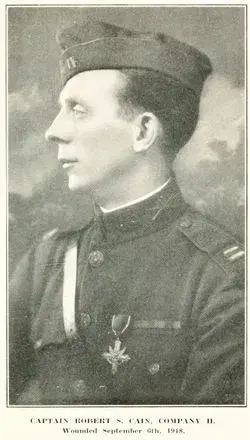
There are many stories of Yanks in the BEF, courageous Americans who crossed the ocean to join the British Army to serve in the trenches of the Somme before their country entered the war. But one Scottish emigre indelibly left his mark on his adopted hometown and marched off to fight with the Pennsylvania National Guard, not once, but three times.
Robert Sneath Cain was born in Lanarkshire, Scotland, in 1878. His parents James and Mary Cain, died while Robert was a young boy, and under these circumstances, he crossed the Atlantic Ocean to the United States at the age of ten.[i] Robert Cain began work quickly in Pittsburgh, working as a “glasshouse-boy” for the McCullough Firm. Having left school early, he took night classes at the local YMCA and public night schools.[ii] In 1898, patriotic fervor hit the city of Pittsburgh. The Spanish American War had broken out, and a call for Volunteers was sent across the country to fill regiments to head to Cuba, Puerto Rico, and the Philippines to fight the Spanish army. A 20-year-old Cain strolled into the Armory of his local National Guard regiment, the 18th Pennsylvania Infantry, known as the “Duquesne Grays”, and volunteered. Like the Territorial Regiments in the United Kingdom, National Guard units were part-time volunteer organisations whose primary duty was to serve domestically to protect the homefront. National Guard regiments primarily had regional identities, tied to small towns or cities, many of them with long lineages of combat service dating back to the American Revolution or even prior as militia forces in colonial service to the British military.
While service in a National Guard regiment was common for men in the era, what set Cain’s volunteerism apart was his status as a recent immigrant and non-citizen. He was not required to serve in the US Military in any capacity. Inspired by the spirit of his adopted home, he entered service with the H Company, 18th Regiment as a Private on 18 June 1898.[iii] The Regiment did not see action in Cuba or the Philippines, but like so many other volunteer regiments at the time, was dispatched to garrison defensive fortifications. Cain and his fellow Guardsman saw service in Sault Ste. Marie, Michigan at Fort Brady.[iv] After five months in Federal service, the 18th Regiment returned to Pittsburgh, where it mustered out of active service. Cain, inspired by the camaraderie and excitement of military service, immediately reenlisted in the National Guard and continued part-time service with the old 18th Infantry.
Cain returned to the civilian sector while balancing his military career. In 1902 he opened his own business in Pittsburgh and sewed on Sergeants chevrons with the Duquesne Grays.[v] In January of 1903, Robert Cain petitioned the District Court in Western Pennsylvania for his citizenship, renouncing his allegiance to the ‘King of Great Britain.’ That same month a Western Pennsylvania judge ruled on Cain’s petition stating Cain ‘being duly qualified, is hereby admitted a Citizen of the United States.’[vi] Now officially an American, Cain soon entered the political realm in Pittsburgh, first becoming a Tax Collector and later a Constable all while running a Dry Goods Store. [vii] [viii] He rapidly rose through the ranks in the National Guard, earning enough confidence from his men to be elected to the Officer ranks. The pressures of civilian life forced him to resign his position within the Guard. When rumors of war on the Mexican Border in 1916 came to the city of Pittsburgh, Cain returned to the 18th Regiment and offered his services again, back at his initial rank of Private. The Regiment accepted him back into service with G Company, and he was elevated back to his last rank of 2nd lieutenant in 24 hours.[ix] Cain was one of 12,711 men of the National Guard of Pennsylvania mobilised for service on the Mexican Border in June. After a brief period of training back at Mt Gretna, they boarded trains and arrived in El Paso, Texas, in July of 1916.[x] The Regiment served along the border conducting patrols, manning checkpoints training exercises, and acted as a general deterrent towards Mexican irregulars under Pancho Villa operating across the border. The 18th stayed in El Paso until December of 1916 as part of one of the most extensive call-ups of part time soldiers in the National Guard in history. The 18th returned to Pittsburgh and paraded on Christmas Day before mustering out of federal service on 5 January 1917.[xi]
Lt Bob Cain and the 18th Pennsylvania would not spend long in Pittsburgh enjoying the comforts of civilian life. With the United States' entry into the Great War, the army faced a drastic need for manpower and reorganisation. The 18th Pennsylvania was mustered into service on 13 April 1917 and pressed into service guarding industry and infrastructure in the Pittsburgh area. Before long, the Regiment was on its way to Camp Hancock, Georgia, where the Pennsylvania National Guard reorganised as part of the rapidly forming American Expeditionary Force (AEF). At Camp Hancock, Lieutenant Cain was elevated to 1st lieutenant in H Company in December of 1917 as he saw the Pittsburgh men of the old 18th Pennsylvania Infantry combined with men from Philadelphia’s 6th Pennsylvania Infantry to for the new 111th Infantry Regiment, of the 28th (Keystone) Division.[xii] By the time the Regiment shipped to France in May of 1918, he would be promoted to captain and commanded the old Pittsburgh company.[xiii]
Upon arrival in France, then Captain Cain and the 111th took on a training regimen under the eyes of Cain’s former countrymen of the 16th Battalion Royal Scots (16/Royal Scots).[xiv] The 111th Infantry was one of the first units in the 28th Division to see combat in the Great War, with two platoons entering the fighting on Hill 204 near Chateau Thierry in June of 1918. At 40 years old, Cain put up a performance that made him ‘adored by every American doughboy with whom he has come into contact.’[xv] During the advance over the Marne Cain led H Company from the front, the Division history recalled that as they approached the town of Epieds, a doughboy from the 26th (Yankee) Division warned Captain Cain that they would be able to advance almost all the way across a wheat field before being mowed down by the German fire. Cain did not relent and led his men forward in the attack. As he reached the edge of the wheat field, he recalled, ‘Here is where it starts, and God help us.’ But the German fire never came; the positions in Epieds had been vacated without a shot. The unit history recalled, ‘for once in his life Bob Cain was speechless.’[xvi]
Not all of Cain’s combat operations were so bloodless. As the Division reached the Vesle River, the 111th Infantry and its parent organisation, the 56th Brigade, was assigned to hold the critical bridgehead between Fismes and Fismette. On 6 August 1918 Cain and his Regiment moved into a reserve position while their sister Regiment, the 112th Infantry, relieved elements of the 32nd (Red Arrow) at the bridgehead. For the next several days, the men of the 111th and 112th faced heavy fire in the town of Fismes. Cain’s 2nd Battalion 111th Infantry (2/111) found itself on the town's western flank and, after patrolling, discovered German resistance to their front in the woods near the famed Chateau du Diable. On August 11th Cain’s unit advanced to secure a section of ground along a railroad that ran parallel to the Vesle River. During the attack, Cain put himself in front of his men, inspiring his men and ensuring liaison with adjacent units at great personal risk.[xvii] Cain, undeterred by enemy fire, grabbed an abandoned Chauchat Automatic rifle and fired burst after burst into the defending enemy machine-gun nests, charging the positions himself and causing enemy gunners to flee.[xviii] Though they successfully took the ground, the fire was so intense that it forced their withdrawal at night, with heavy casualties. Cain and his First Sergeant, Raymond Reisker, crawled forward cut a hole in the wire entanglements by the river, allowing his men to slide through and float down the river back to their jump-off positions, unobserved by enemy gunners.[xix]
After the loss of several officer’s Cain was placed in command of the entire front-line positions of the 2/111 in Fismes. With the violence of the fighting increasing by the hour, Cain assessed the situation of his Battalion and found it in a grim state. Pockets of men were clinging to positions in destroyed chateaus and industrial buildings. He did what he could to shore up the lines and motivate the men. In a report dictated to his former First Sergeant, he sent back the following message to his command: ‘Send us ammunition, some grub, if possible, and we'll hold this line until hell freezes over.’[xx] The 111th held their sector along the Vesle until 14 August 1918, and then after a brief respite in Dravegny, they returned to replace battered elements of the 112th. The fighting raged around Fismes for weeks. Units rotated in and out of positions on both sides of the river. The history of the 28th Division recalled the action on the Vesle as some of the most severe the men would encounter the entire war. ‘The town of Fismette was the scene of much hand-to-hand fighting, severe gas attacks, and the introduction of the 111th to German liquid fire.’ [xxi]
Fismes would not be the last fighting for Bob Cain and his men in the Vesle Sector. Withdrawn from Fismes itself, the 111th took positions near Courlandon and prepared for their final advance of the Oise-Aisne Offensive. At 01.00am on 6 September 1918 from the heights near Fismes, Captain Cain led front-line elements of F and H Company, and some attached Machine Guns forward with elements of the 109th Infantry to their left and French forces to their right.[xxii] The offensive move was disastrous. The initial barrage covered the opening advance, but rapidly the men faced a web of interlocking fires from German machine guns. Soldiers from Cain's command fell all around him, including his old First Sergeant Reisker and other senior Noncommissioned Officers. German counter-battery fire landed among the advancing Americans and slowed their advance to a crawl, but they continued forward. While leading from the front yet again, Captain Bob Cain was shot through the shoulder by enemy machine-gun fire. [xxiii] He wouldn't be the last officer to fall from his command, as nearly every senior leader between the two line and machine-gun companies were struck down by enemy fire. The advance ground to a halt as wounded poured back through the American lines on improvised stretchers of blankets and shelter halves. With this stalled attack, the 111th would be withdrawn from combat, pulled back to rest areas in Mogenville, Contrisson, and Beurey. The fighting along the Vesle cost the 111th astounding casualties. Over 450 men would be killed, nearly 1,000 wounded, combined with their initial losses along the Marne. As the 111th marched back to rear lines, roughly half of their numbers had fallen as casualties, among them the Scottish Captain ‘Fighting Bob Cain.’[xxiv]
Cain would miss the 28th Division's brutal fight in the Argonne Forest, spending his time in a French Field Hospital. For his actions leading his men from the front at Fismes, he would be awarded the Distinguished Service Cross, the army's second-highest award for valor. The French Government would also bestow him the Legion of Honor and the Italian Government the Italian War Cross.[xxv] He would return to the United States in January of 1919 for further medical treatment, beating the rest of his regiment back by several months. When the men of the ‘Old 18th’ returned to Pittsburgh on 8 May 1919, Captain Cain, invalided home but not with a broken spirit, would meet them at the train platform and escort them to their welcome home parade and festivities.[xxvi]
Cain's injuries and war service would not keep him out of public service for long. In September of 1919, now a local celebrity, he was noninitiated and elected as the County Commissioner of Allegheny County and held multiple elected positions in the city until 1934.[xxvii] ‘Fighting Bob,’ was also a vocal supporter of veteran’s organisations, joining and leading multiple veterans’ groups. Cain was a constant in Memorial Day and Armistice Day parades in Pittsburgh and was noted for being one of the final surviving local veterans of the Spanish American War.[xxviii] Cain even provided hospitality to visiting British War Veterans to the city in 1927, hosting a reception at a local veterans’ hall.[xxix] Cain was no stranger to Europe in retirement either, making repeated visits back to the continent. In a tour of France and Germany in the 1930's he even met with a German Machine Gunner he had captured just hours before his own wounding a Courlandon.[xxx]
Cain was a unique soldier in the American Expeditionary Force. At 40 years of age, he was likely one of the oldest junior officers in the 28th Division. He was experienced in soldiering as well, with 20 years in uniform by the time he stepped off the transport ship at La Harve. But in many ways, Cain’s story is like that of other ‘New Americans,’ as they were called in the AEF.[xxxi] Immigrants who left behind old lives in Europe only to return in time of war. Cain came to the United States from Scotland looking for opportunity, and when the country entered a war, Cain opted to pay back his adopted nation by putting on a uniform. Alongside men like Captain Robert Cain there were many other immigrant warriors in the 111th Infantry. Soldiers such a Sergeant James Mestrovich, born in Montenegro, who would earn the Congressional Medal of Honor in Fismette only to later fall in battle a week before the Armistice. Fellow Scotsman Donald McCrae, a veteran of the Royal Artillery who emigrated to the US after is service in the British Army, would fall in the Argonne serving with B Company of the Regiment. Cain survived the war unlike many other immigrant soldiers in the Regiment and returned home to the United States and thrived in the post-war era. Still, he never forgot the fellow soldiers with whom he earned respect and reverence of an adopted nation.
[i] Western Pennsylvanians: A Work for Newspaper and Library Reference, Charles A Rook, ed., (Western Pennsylvania Biographical Association: Pittsburgh, 1923), p.227.
[ii] Ibid, p.227.
[iii] Thomas Stewart, Record of Pennsylvania Volunteers in the Spanish-American War, 1898 (State Printer: Harrisburg, 1901), p.721.
[iv] History of the 18th Regiment Infantry “Duquesne Grays,” (National Guard of Pennsylvania: Pittsburgh,1901), p.93.
[v] Ibid, p.34.
[vi] Robert S Cain, “Petition for Citizenship in the United States,” Western District of Pennsylvania, 6 January 1903.
[vii] “Business Before Town Council,” The Daily Notes, (Canonsburg, Pennsylvania) 27 October 1906, p.1.
[viii] “Kills Self When Arrested,” The Pittsburgh Press, (Pittsburgh, Pennsylvania) 15 February 1910, p.1.
[ix] Western Pennsylvanians, p.368.
[x] Charles H Harris, Louis R Sadler, The Great Call-Up, (University of Oklahoma Press: Norman, 2015), p.299.
[xi] Pennsylvania in the World War, Vol. II, (Pittsburgh: State Publications Society, 1921), p.276.
[xii] Pennsylvania in the World War, Vol. II, p.282.
[xiii] Robert Sneath Cain, “Veteran’s Compensation Application,” Commonwealth of Pennsylvania, 1935.
[xiv] Pennsylvania in the World War, Vol. II, p.300
[xv] Western Pennsylvanians, p.368.
[xvi] Pennsylvania in the World War, Vol. II, p.320
[xvii] “Citation: CPT Robert S.Cain, Distinguished Service Cross,” War Department General Orders No. 37, 1919.
[xviii] “Real Fighting Man is Bob Cain,” The Pittsburgh Press, (Pittsburgh, Pennsylvania), 21 September 1929, p.7.
[xix] George Cooper, Our Second Battalion: The Accurate and Authentic History of the Second Battalion 111th Infantry, (Second Battalion Book Company: Pittsburgh, 1920), p.93.
[xx] Our Second Battalion, p.97.
[xxi] Pennsylvania in the World War, Vol. II, p.517-518.
[xxii] Our Second Battalion, p.113.
[xxiii] Our Second Battalion, p.114.
[xxiv] “War Hero ‘Fighting Bob’ Cain Dead, Pittsburgh Post Gazette (Pittsburgh, Pennsylvania), 18 November 1961, p.12
[xxv] Pennsylvania in the World War, Vol. II, p.494.
[xxvi] Paul Compton and Wendy Yessler, Private Compton: My experiences in the World War or a Brief History of the Third Battalion 111th Infantry 28th Division AEF, (WAY Art & Life Design: 2019), p.239.
[xxvii] Western Pennsylvanians, p.368.
[xxviii] “Spanish War Veterans Ready for Encampment,” The Pittsburgh Press (Pittsburgh, Pennsylvania), 31 August 1913, p.24.
[xxix] “British War Veterans,” The Pittsburgh Press, (Pittsburgh, Pennsylvania), 25 December 1927, p.8.
[xxx] “Captain Cain and War Captive Meet Again As Berlin Cringes with Nazi Blood Purge,” The Pittsburgh Press (Pittsburgh, Pennsylvania), 9 August 1934, p.4.
[xxxi] “Only Pennsylvania Man Honored by Congress Nominated for Niche,” Pittsburgh Post Gazette (Pittsburgh, Pennsylvania), 22 June 1921, p.3.