Hill 204
By: Aaron Heft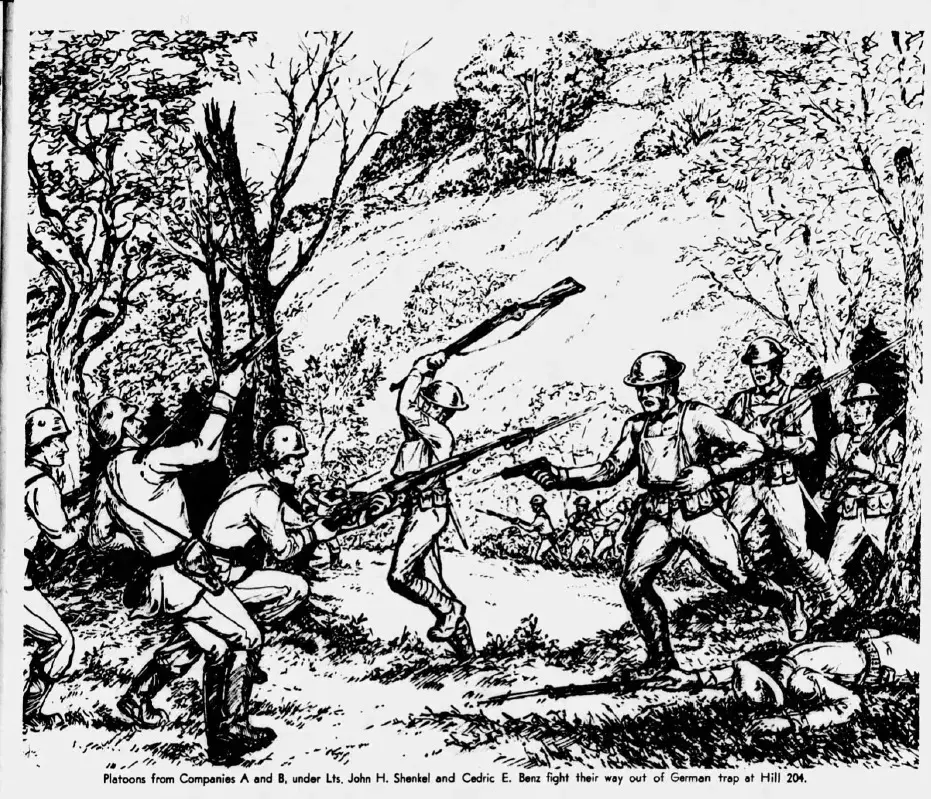
Most histories of the 28th Division mark their entry into the war with the climactic actions along the Marne on July 15th, 1918. There the Division fought alongside French troops of the 125th Infantry and their doughboy brothers of the 3rd Division grinding a German Offensive to a halt and earning the nickname “Men of Iron” from General Pershing. While this fighting near Chateau Thierry in mid-July would place the Pennsylvania soldiers in the headlines of newspapers across the nation, a small action a few weeks earlier on July 1st would mark the true baptism of fire of the keystone state’s doughboys. On that day a small patrol numbering just 116 men would climb the shell scarred sides of Hill 204, where the American monument to the battle now stands. Alongside their new French comrades, they would attempt to secure a small foothold in support of larger operations near Vaux. While a comparatively unimportant action in the scheme of the war, the fight on Hill 204 would demonstrate to the veteran French the fighting ability of Pennsylvania’s part time soldiers. Hill 204 would create the Division’s first heroes and would mark the moment that the 28th Division began its transformation to what their Corps Commander Robert Bullard would later call “an A-1 Shock Division.”
Pennsylvania’s 28th Division has the distinction of being the oldest division in the United States Army, formed when the state organized its entire National Guard in a single division structure in 1879. Elements of the organization saw service in Puerto Rico and the Philippines in 1898, and the division deployed to the Mexican Border in 1916, where it was reflagged the “7th Division.” Only a few weeks upon returning from the border mission, the men of the National Guard of Pennsylvania were called back into active service guarding important infrastructure from Pittsburgh to Philadelphia. After a few weeks of local duty the units mobilized to Camp Hancock, Georgia where they would undergo their transformation from a state unit, into the 28th Division AEF. From Hancock the men of the 28th would make their way across the Atlantic to England, and then the rear area lines where they would train under the tutelage of the Sixteenth Battalion Royal Scots, a premier highland regiment in the British Army. By the end of June the 28th Division moved out of the British sector and under the command of the 39th French Division, where they would begin service as a front-line unit under the direction of combat hardened French commanders. Despite this long legacy and modern training, some in the AEF command feared that National Guard units, especially their leaders, would be ineffective in action.
After only a few short days in the French lines the 28th Division’s lead regiment, the 111th Infantry received a request to supply two platoons of American doughboys to accompany the French 153rd Infantry in an attack on Hill 204, a German outpost above the town of Chateau Thierry. While the attack would be good on the job training for the 111th Infantry, it would also serve as a supporting attack to a larger push on the town of Vaux by the AEF’s 2nd Division to break the German lines around Hill 204. Headed by Spanish American War Veteran and long serving National Guardsman Colonel Edward Shannon, the 111th Infantry drew guardsman from Pennsylvania’s two largest cities, Philadelphia, and Pittsburgh. The unit was the first element on ground from the 28th Division in France, and many of the men were ready for action. Colonel Shannon ordered two Lieutenants from the lead companies, Lieutenant Cedric Benz of Company A, and Lieutenant John Shenkel of Company B, both pre-war guard officers, to assemble a platoon each for action with the French.
Benz returned to his unit and assembled a group of picked men, the top performers of his company. Sergeant Bob Hoffman recalled that as the Lieutenant looked to select volunteers for the raid “the entire company, like one man stepped forward.” Hoffman helped Benz select the first men into action and noted that “men who did not get to go on this trip cried real tears” as their comrades left them behind to become the units’ first combat veterans. Lieutenant Shenkel selected his own platoon in entirety for the raid, but despite only recently arriving in France many of the men required a refit of combat equipment before stepping off. Lieutenant Hervey Allen, another platoon leader in Shenkel’s company, had to “strip one or two men in the other platoons of their ammunition to supply missing clips” and “picked out the best automatic rifles and extra magazines” to disperse among the men. Within just ten minutes of receiving the order the two platoons reported to French liaison at Basseville.
Once transported to headquarters of the French 153rd Infantry at Moucherelle, Shenkel and Benz were briefed of their mission through interpreters and moved to the woods on the outskirts of Hill 204 at 0300 on July 1st, 1918. For twelve hours the platoons observed their target area with French troops, and finally at 1600 they witnessed the preparatory barrage from French artillery. Sergeant Hoffman recalled that the men demonstrated their bayonet skills to their French comrades and observed their allies preparing the needed supplies for the attack. At 1800 the French troops and their American attachments leapt forth from the wooded edge of Hill 204 and began a climb towards German positions. Almost immediately the platoons came under heavy and accurate German machine gun fire. In the opening barrage of the attack Shenkel and his platoon split to the right, while Benz and his men moved towards the left.
French commanders would later write that “from the beginning of the attack the American detachments were marked by their ardor, bravery and their enthusiasm.” As the men of the patrol advanced into the wooded edge of the hillside they entered an almost immediate hand to hand combat with the enemy. As they clubbed and fought their way forward gas, trench mortars, snipers, and machine gun rounds impacted around them. The training gleaned from their battle-hardened French allies kicked in almost immediately and the platoons put their new weapons to good use.
Benz and his platoon charged forward, employing short rushes through the wooded terrain to limit their exposure to fire. Sergeant Bob Hoffman recalled that after a bullet ricocheted off of his helmet he “forgot the line of combat groups and we fought just as our ancestors had always fought…rushing forward, stopping to shoot, rushing again, and shooting again.” Snipers in the wood line however picked targets and men from among the platoon dropped across the front line. The casualties mounted among the platoon, Hoffman was struck several times in his advance, and Sergeant George Amole of Pottstown PA, a veteran guardsman with 16 years of service under his belt and the senior NCO of Benz’s platoon was felled by German machine guns. The loss of their senior NCO would not stop the advance of the Pennsylvania soldiers, and other leaders stepped into the void. After watching one of his Automatic Rifleman fall in action, Sergeant William Felix of Avalon, PA grabbed his Chauchat Rifle and ordered his runner Pvt James Early of Pittsburgh to “follow me with ammunition.” The pair leapt forward through the fire and suppressed the enemy trench line from an exposed position, covering the advance of the remainder of their platoon and allowing them to advance and take positions in the trench. While the handful of unscathed survivors tumbled into the German trench Hoffman remarked that Felix who had taken a wound to the face and Early, who was wounded by thirteen different pieces of shrapnel still manned their gun. Lieutenant Benz also made it to the trench, and with the aid of the wounded Hoffman and Private Samuel Smith managed to round up the remaining 38 German soldiers and their Sergeant. Hoffman himself grabbed an abandoned Chauchat and pushed forward into the wooded terrain around the trench, trading fire with a few Germans. The battered men of A company consolidated their gains, and set up defensive positions in the trench preparing for an expected counter attack.
On the right of the American advancetheir compatriots in B company faced a similar situation. Shenkel’s platoon faced a barrage of concealed machine gun fire which rapidly pinned down his advance. To quiet the German guns Private First Class James Griffin of Pittsburgh, along with Francis Hannigan and Thomas Jordan shouldered their French made Chauchat Automatic rifles and targeted hidden German positions throughout the tree line, silencing them with what their Lieutenant would describe as “daring work.” The Platoon pushed forward through the trees, but like their comrades on the other side of the advance, they suffered heavily as experienced leaders fell across the formation. Recently promoted Sergeant James D Ralph, one of Shenkels senior NCOs fell wounded directing fire of his men from an exposed position. Despite their losses Shenkel’s men somehow made it through and forced their way into the German first line trenches. The Lieutenant and seven of his men pushed past the trench in pursuit of fleeing Germans and quickly found themselves cut off an surrounded. As German troops demanded his men’s surrender Shenkel felled a German officer with his pistol, and his men fought their way back to the trench with bayonets and rifle butts in a brutal hand to hand contest. For hours the remnants of his platoon held their position, repulsing a flanking counterattack and inflicting heavy losses on the advancing Germans.
Overnight, German forces fired a creeping barrage and attempted to pierce the lines with patrols and counter attacks, but the men of the 111th Infantry held on. In the early hours of the morning on July 2nd German gas shells screeched into the lines, but an immediate alarm by the Pennsylvanians warned the men to don their respirators and limited the effect of the German shells. At 0430 hours French reinforcements of the 153rd Infantry relieved the Pennsylvanians in place. Of the 116 men who stepped off from French trenches the day prior, only 63 would walk down Hill 204 unscathed. Colonel Matter of the 153rd wrote to Colonel Shannon that “The attitude of all American ranks, especially the noncommissioned officers participating in the attack… were superb in their enthusiasm and courage. I would appreciate it very much if you would bring to the knowledge of your regiment the splendid conduct of your men, who fought the first time with us, and let everybody know that with such admirable soldiers as yours, and ours, the defeat of the Germans is certain in the near future.”
The return of the survivors of the two platoons brought back the realities of war to their regiment. Nearly half had been killed or wounded, and several were missing among the foliage and trenches of Hill 204. As Lieutenant Hervey Allen met his fellow platoon leader Shenkel returning from the action he noted that his calm veteran like actions on the hill had made him “idolized by his men.” Beyond the glow of the men’s adoration, Allen saw a different characteristic in Shenkel “a story of agony and pain, of death in a furnace…Shenkel was alive only by a series of miracles. His face was flushed, eyes brilliant with excitement. He was a different man.” The men of the company would make their way to Hill 204 a few days after the fighting, and for the first time would witness the carnage experienced by their brothers. “They had remained unburied for two weeks, and lay just as they had fallen, some evidently trying to help a wounded comrade…others had been shredded beyond recognition, and all were in terrible conditions.” In only a few short days the fighting along the Marne would engulf the rest of the 111th, and make veterans of the the men so awed by Shenkel, Benz and the other heroes of Hill 204.
For their actions on Hill 204 Lieutenant John Shenkel, Lieutenant Cedric Benz, and 18 of their men would receive the coveted French Croix de Guerre. Both platoons would receive a unit award of the Croix de Guerre as well, the only organization of their size in the 28th Division to receive such an honor. Benz and Shenkel, however, would not get to put their hard-won combat experience to use. Shortly after their action both officers were withdrawn from the lines and shipped back to the United States to tell their tale of heroism.
The 111th Infantry, and Pennsylvania’s 28th Division would go on to fight in the Second Battle of the Marne, over the Vesle River at Fismette, and in the Argonne Forrest. By the wars end the casualties and actions on Hill 204 were only a few lines in the unit’s official history. While the story of Hill 204 is often forgotten today, it marks a moment when Pennsylvania’s National Guard demonstrated to the Allied cause that they were ready, willing, and able to take the fight to the German Army.